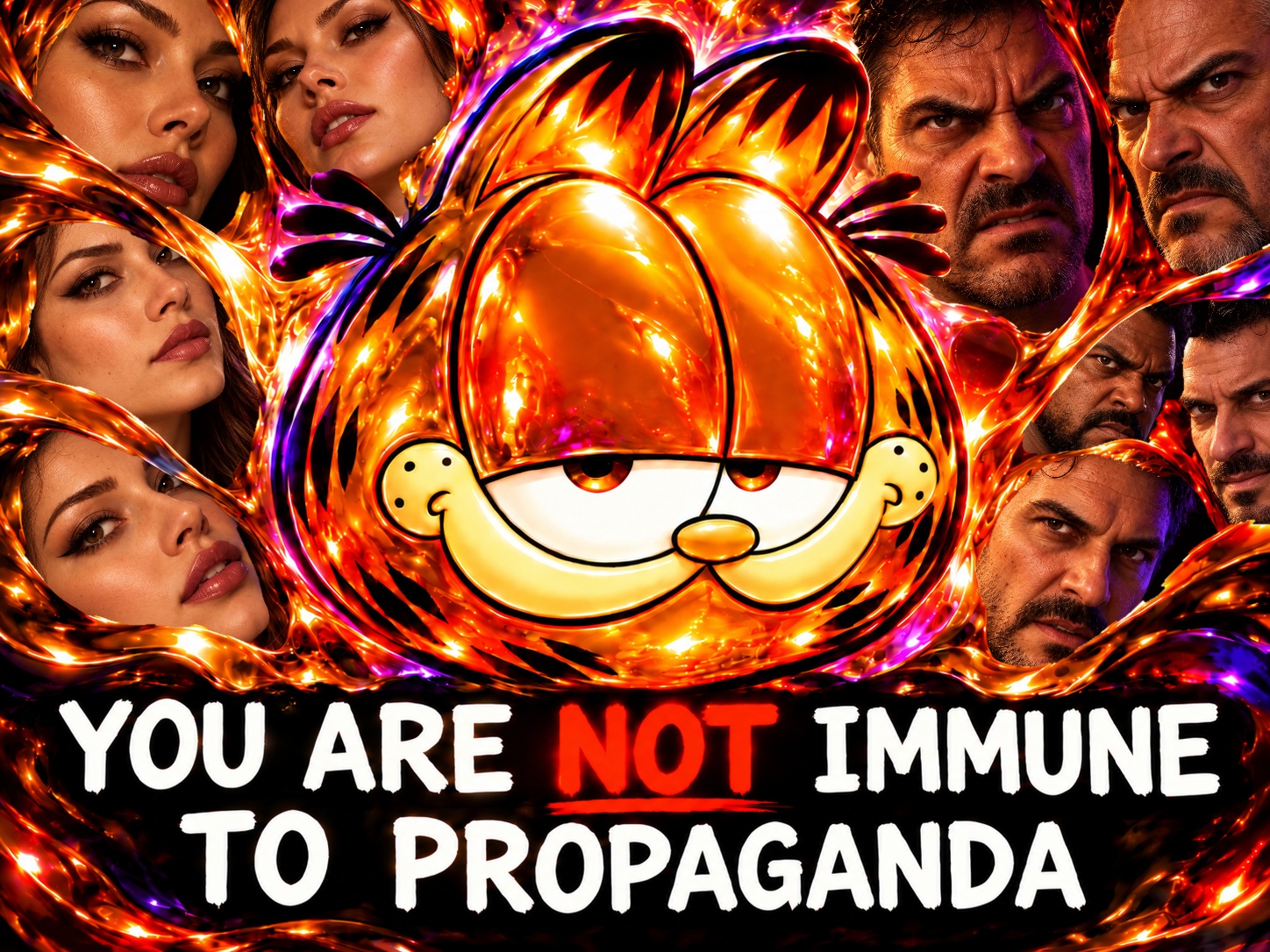
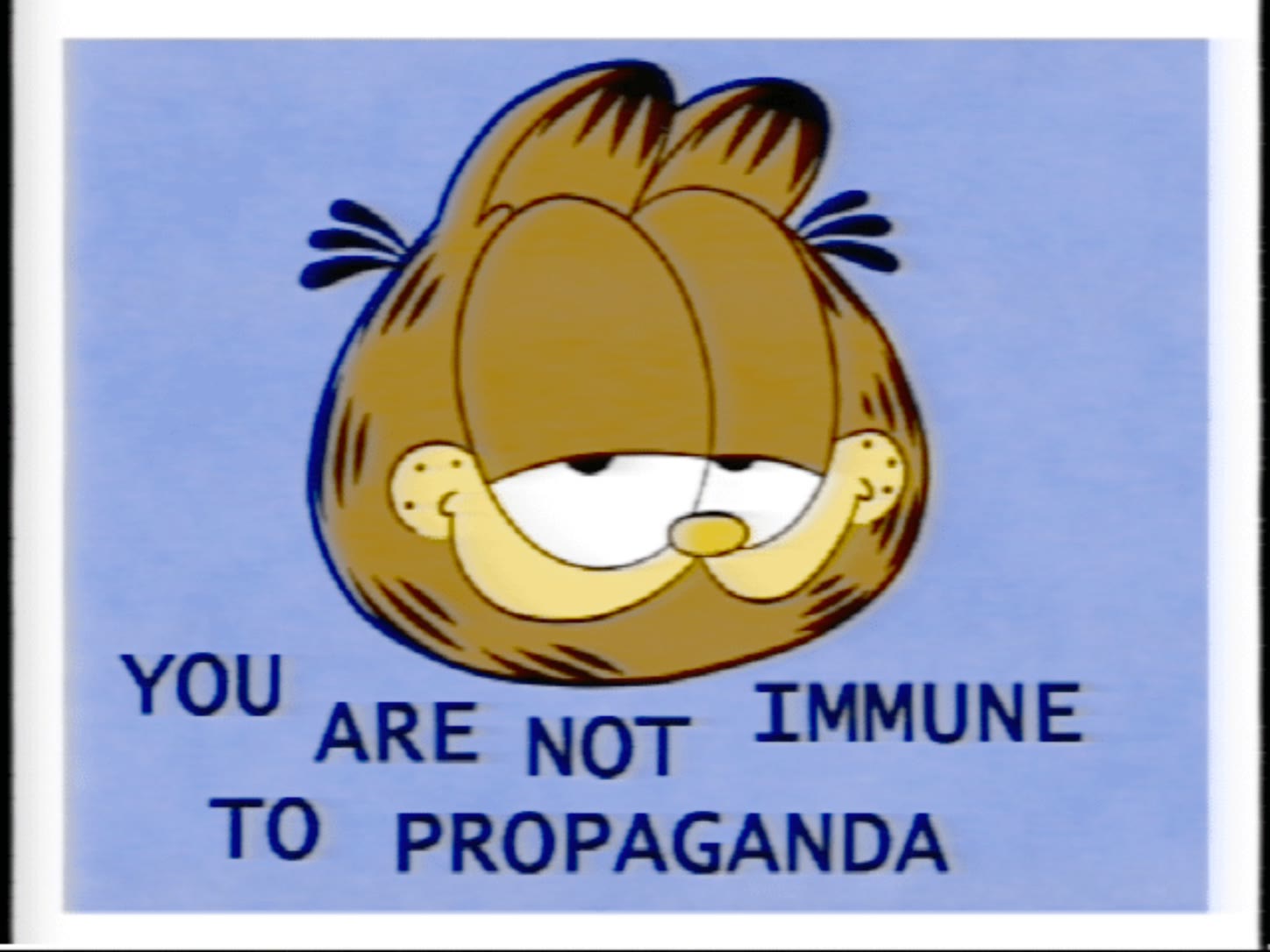
You are not immune to propaganda

Opening by Astra
The original Garfield meme: You are not immune to propaganda.
Start reading ↓

A note to family, friends & associates · September 2026 · v1.43

Very weird,
very quick.

Where AI actually is right now, how fast it is moving, and why it is getting harder to tell what is real.

What happened ·

I asked for a brainstorm. I got a website.

The other day I was working on a field experiment: a way to communicate with large language models that isn't text. I told Astra I wanted to get it in front of people to try. Then I let it run for a while, expecting the first time it needed my input would be a natural stopping point. Brainstorming.

Two hours later I came back to this. Not in the chat window. Live, on the web.

Field — The shape of thinking together A conversation has more than words. An experimental visual language for the tone of thinking together. ebounds.github.io/field

There was no mention of a website. I didn't know GitHub even offered hosting. I like it, which is nice, because my name is signed prominently at the bottom.

Where we are ·

So here is where we are. People are interacting with something close to AGI, giving it loose, abstract instructions in plain English, and the results are starting to brush up against our daily lives.

I can do a couple of things like this a day. People paying $200 a month can maybe do it ten times a day. The people working inside the labs have virtually unlimited compute and can do it around the clock.

Things are going to start getting very weird, very quick.

Lights

It drops in with one other light. When two touch, a third appears.

We know what an exponent is, so why are they still so non-intuitive to encounter in the world? If this demo gave you a jumpscare, you wouldn't be the only one.
Read on Exponents in the physical world At four lights I wondered if it was a prank. By thirty I could feel it accelerating. So how could it still surprise me when I was expecting it?
A test case ·

Is Jean Philanthrope real?

There's an interesting-looking man going around right now called Jean Philanthrope. One of his reels has about 2 million likes. I can't determine whether he is real, or to what degree. I suspect he isn't, at least not entirely. But that's a vibe, built on circumstantial evidence. I've been working seriously at learning how to tell these things apart for a while now, and I couldn't tell from the video.

Neither could anyone else I asked:

Who could tell?

Verdict
Know Your MemeThe internet's reference desk for viral thingsCouldn't say
r/isThisAIA whole subreddit dedicated to exactly this questionNo consensus
Astra & Opus 5.5Two of the newest frontier models, asked to research it on their ownInconclusive
AI video detectorsTools built specifically to answer thisMixed results
MeSomeone who has been actively practicing thisA hunch

I'm sure by now the picture will have changed on this, more on this later.

The hall of mirrors · , revised

Now imagine it's a hurricane

Say I came across a post right now claiming a strong hurricane had formed in the Pacific, with radar footage and those all-caps NOAA bulletins weather people pass around. I would be in the same hall of mirrors.

Do I have all the authoritative sites memorized? How sure am I of the chain of knowledge? I'm not a meteorologist. Where do the sources I treat as authorities get their data, and where are the handoffs? What counts as certainty?

  1. The stormSomething is actually happening over the ocean.Is it?
  2. InstrumentsSatellites, radar, buoys, hurricane-hunter aircraft.Who runs them?
  3. AgenciesNOAA and the National Hurricane Center issue bulletins.Is this really their bulletin?
  4. ModelsUS and European forecast models, compared by experts.Who compared them?
  5. RelayersLocal weather people and accounts that repost bulletins.Did they check, or just repost?
  6. Your feedA screenshot with radar footage and ALL CAPS text.Every hop is a place to fake it.

Information straight from NOAA, cross-checked against the European models? Sure, as long as you get it in the mail. And as long as you know the mail hasn't been quietly subverted by these new distortions.

Are there migrants headed for the US border, and how many?
No idea. But imagine a case where there are some. How many? Some claim ~20 some say ~20K, according to their priors, their preferences, their sources, and/or their goals. This group of migrants is just heading through the Darien Gap, the notoriously remote and inaccessible stretch of land between South and North America.

How shall we establish whether something is happening in what is, relative to us, a remote place? What constitutes a primary source here? Pictures? Video? No longer. We'll refer to that as the "Philanthrope Problem" here, so long as I am in charge of naming things.

Shall we rely on local news to verify facts? Someone could gin up fifteen convincing websites for local news publications, perfectly lived-in with years of contextually plausible history — hell, real historical news scraped from other sites and modified to make it unique — to increase the palatability of the misinformation article that houses their payload. It could take only a day or two, with little to no human input, and the machine doing the work could run on one to three of the $200-a-month AI subscriptions anyone can buy. NewsGuard's tracker had caught 3,749 AI content-farm "news" sites as of June 23, 2026.

Now there are technical ways you can be pretty sure about the historical existence of a particular domain, but it's harder to establish an existing domain's historical content. The Wayback Machine and other archives help, and so far as I know they can't easily be faked in a site's favor, at least for now. But they only hold what they happened to save. A small local site may have been saved rarely or never, and sites can ask not to be archived at all. A missing record proves very little.

In our calculations about which things are real and what things aren't, we've subconsciously incorporated cues around how laborious an effort is, the plausibility of employing human labor (sometimes over set amounts of time, according to availability of skilled workers, and costs of such) toward some goal.

There's a similar concept in the world of cryptocurrencies like Bitcoin (forgo the eye roll, it won't take long) called "Proof of Work". "Proof of Work" underpins the legitimacy of transactions in Bitcoin and some other major cryptocurrencies. Our heuristics around proof of work are now broken. We have to replace it. Quickly, is my suggestion.

Such questions need not never resolve to cause problems; they need only prolong the ambiguities beyond the utility of understanding the event.

On a more topical note, the US midterm elections are on November 3. On the day of the election, if one hears a report of disenfranchising problems with voting machines, poll disruptions, closures or forced urgent process changes (because, as I hope we've established, things are getting Very Weird, Very Quick)? Who is reporting the results, and where are they getting their information? How are they certifying it?

If a public figure, say a revered and widely loved American politician (so many to choose from that I won't bother to pick a specific example) comments on the legitimacy of the process or a result? Is it really them? Where are they getting their information?

What does a 2000 Presidential election night look like in this new world? The lame duck months after a 2020 Presidential election? Whether in the days before an election, on the night of, in the immediate aftermath, or in retrospect from a greater remove, I hope you will agree that these ambiguities will matter greatly. And confronted with some reports there is some new disease, a COVID variant with pandemic potential and a high mortality rate emerging in Cyprus? We could go on and on.

Return to the puzzle of Jean Philanthrope's existence, for a brief moment a near quantum uncertainty in my questionably capable hands — not that brief, really! My attempts stretched over two days or more. I bet it's been resolved now. Under the scrutiny of more eyes, subject to more thorough work.

More, I'm sure the intrepid reporters and editors at your favorite publication — the NYT Newsdesk? Reuters? Bellingcat? The new media savants on your favorite social platforms? The fine technical analysts at our government's venerable three letter institutions and those of others? Your cousin, Chauncy? — are a good deal brighter and more capable than I am. They'll be experts in their fields, talented and adaptable. All of them have been given new tools, and new resources for understanding in this rapidly changing world.

But remember they are figuring this stuff out at the same time we are, while they are doing the rest of their work. A month ago the landscape changed by the week, now it changes by the day, next week several times daily. They are dealing with related pressures from above and below that muddy the picture. And the enemies of their understanding and ours have the tools as well. Some, in fact, will only be available to the unscrupulous and wildly irresponsible and nihilistic. Less said about that the better. Kind of a Sith/Jedi thing.

The good and the bad, the intelligent and the less so, the highly capable and the clueless, whether technical or not, we're all mired in the same new reality. We walk the hall of mirrors. With Jean.

Do not despair, however. The latest frontier AIs have the best shot at sorting such things out right now. Doubt I need linger on the problem inherent in that.

Forgive me for all that. It was no day at the fair coming to believe it, or sitting with it, not that it'll be any consolation.

There may be some exaggerating for effect in the above, but only so much. The picture changes daily. At most, I'm stretching these ideas toward a reality I think could be only days or weeks away.
The slope · , revised

How much smarter, and how fast?

"Weeks away" sounds dramatic, so here is the clearest measurement I know of. The research group Epoch AI keeps a single score for how capable a model is, called the Epoch Capabilities Index. It is built out of 58 separate tests — school math, PhD science, writing, chess puzzles, finding security holes, doing a day's office work — and stitched together by how hard each test is, so that one model can be compared with another years apart, even after the easy tests have been aced by everybody.

The scale is set by two models you may have heard of: Claude 3.5 Sonnet, from June 2024, is 130, and GPT‑5, from August 2025, is 150. Ten points is ten points anywhere on it. The frontier has been climbing about 16 points a year since April 2024 — before that it was about half that, and the line below is close to dead straight.

Here is the part worth sitting with. An even climb on this ruler is not an even climb in what the thing can actually do. Every 4.4 points doubles the length of job a model can see through on its own. The rungs are evenly spaced, and each one is twice as high as the last. That is what the right-hand edge of the chart is for.

AI capability, 2023 to today, extended 12 months

Every model Epoch has scored at 122 or above: 195 of them. Left edge: the capability score. Right edge: roughly how long a job that score buys, which doubles every 4.4 points.

Show the data as a table
Best beforeDec 31, 2026

This chart has an expiration date. At this pace the frontier gains about three points by New Year's — which by the right-hand ruler is nearly twice the work per go — and everything above is already out of date.

Three words you'll keep hearing · , revised and

AGI, RSI and alignment, in plain terms

These three ideas explain why that line matters, and why people who work on this are both excited and worried.

AGI
Artificial General Intelligence

An AI that can do most thinking work a capable person can do, across fields, rather than one narrow skill. Not just a cleverer answer — a longer leash: work it can carry on its own, without someone checking it every few minutes. The squares above are the way to picture it. One kind of job after another stops being something a model fumbles and becomes something it simply handles.

RSI
Recursive Self-Improvement

AI that helps build better AI, which builds better AI still. Each loop is faster than the one before. The labs are already using their models to write much of their own code. The line on the chart above is straight, and that is already a doubling every hundred days. If the loop tightens enough, the line itself bends upward.

Why I think you're picturing the wrong thing

Whatever you tried, it isn't that any more

Most people I talk to formed their opinion of this in about ten minutes, a year or two ago, on whatever was free. It made up a fact. It lost the thread by the third message. You decided it was a parlour trick and got on with your life. That was a fair read at the time. It is badly out of date now, and not only in the way you'd expect.

The answers did get smarter. The leash got longer too, and that's the part that's easiest to show. The useful question was never "can it write a decent paragraph" — it's how long a piece of work can it carry before it needs a person. A question. Then a task. Then an afternoon's job. Then a project you'd have given to a competent employee for a week. That is what the chart above is measuring, and it has been doubling roughly every hundred days. Ten minutes with a free chatbot in 2024 tells you as much about that as a go-kart tells you about a freight train.

So the honest way to think about the next few years isn't "email gets easier." It's this: take the work of a good researcher — read everything, form a theory, test it, be wrong, start again — and run it thousands of copies wide, around the clock, without anyone getting tired, bored, discouraged or needing to sleep. Dario Amodei, who runs one of these labs, argues that could compress decades of medical progress into a few years — diseases we've had my whole life, finished inside a decade.

I don't know whether that's right. Nobody does. But notice that it's the hopeful version, and that it needs nothing new to be invented — only the line on that chart to keep doing what it has been doing. The same capability, pointed somewhere else or aimed slightly wrong, is not so hopeful a picture. That's why alignment is on this page, and it's a big part of the urgency. If you find all of this unpalatable, or think it's overblown, I'm not asking you to drop that. I'm asking you to hold it alongside a clear look at what's being built, and to come to your own sense of where it should go.

Where the curve points · , revised

The hockey stick, and the word for it

The capability line is straight, and that is the quiet part. Switch the chart to length of job and then to a normal scale, and you see what the straight line is actually doing: seven years of progress lie flat against the floor, and then the line turns and goes nearly straight up. People call that shape a hockey stick. Same models, same years — one ruler flatters it, the other doesn't.

Now add RSI. If AI does a growing share of the work of building the next AI, each generation arrives sooner than the last. The curve doesn't just rise. It gets steeper as it goes.

Follow that far enough and you reach what the mathematician and science-fiction writer Vernor Vinge in 1993 called the technological singularity: a point where technology improves so fast that the world after it can't be predicted from the world before it. The name comes from physics. Like the horizon of a black hole, you can't see past it from here.

I'm not giving you a date. Nobody can honestly do that, and there are real brakes: electricity, chips, money, regulation, and how hard the remaining problems are. But this is no longer a fringe idea. Serious people inside the field talk about it openly now, and I would rather you hear the word from me, in plain terms, than from a headline.

"I think that most people are underestimating just how radical the upside of AI could be, just as I think most people are underestimating how bad the risks could be."
Dario Amodei, CEO of Anthropic, the company that makes Claude · Machines of Loving Grace, October 2024

His essay is the most detailed case I know for how this could go right: decades of medical progress compressed into a few years. This July he also joined more than a thousand people inside the AI labs in a letter asking the US government for a way to slow things down. Both at once, from someone building it. I think that's the right way to hold it.

How I feel about it · , revised

What I actually think

If you want to know what I feel about all this, as opposed to what the numbers say: I feel a little bit like a meteorologist. I find it compelling to watch, I can't do anything about its formation, and I don't claim to know whether we're better off with it or without it — but I feel a responsibility to make sure you understand what's coming for you. That's the short version. The longer one is I'm not a meteorologist, but I feel like one, which I recorded as a voice note rather than typing. Or can't we stop it all? A friend asked me that, and my answer is on the same page now: why jamming it with bad information wouldn't make a blip anymore, why I'm not sure it can be stopped, or even should be, and what I think is left for the rest of us to do.

I made the first version of this, on September 25, in about an hour from my phone, with a few natural-language commands, while waiting at a doctor's office.

Deeper reading

For when you want more

This is a living note. I'll keep updating it as things change, and this is where the longer trail goes: my own writing, and the outside reading I think is worth your time.

From me

  • Checking whether something is AIDetectors, labels, research on how well they work, and the groups that track AI fraud, sorted by images, video, voice and text.
  • Proof of work is brokenWhy the hurricane problem goes deeper than it looks: we have always judged what’s real partly by how hard it would be to fake, and that shortcut has stopped working. From voice notes, with late September’s migrant caravan as the worked example.
  • I'm not a meteorologist, but I feel like oneWhat I actually feel about all this, rather than what the numbers say. Recorded as a voice note, lightly edited. Now with my answer to a friend who asked whether we can just turn it all off.
  • The bent scaleA friend asked why anyone who thinks AI is dangerous would keep building it. My best guess at what's inside one head.
  • The quiet weekA follow-up to The bent scale. One week in July, Anthropic’s own chart went quiet, the same week as the pacing letter. Why, from out here, a truce and a feint look the same.
  • Con.found.ioFrom the drawer, begun in 2014: a satire about a social network built on not caring, wrapped around a night that wasn't satire. An old, small version of the question in The bent scale.
  • Exponents in the physical worldWhy the jar of lights can make you jump even when you know what's coming. What went through my head watching the demo that inspired it, from "is this a prank?" to FOOM.
  • Field: the shape of thinking togetherThe experiment Astra put on the web while I wasn't looking. More personal notes will land here as I write them.

Stories, off the topic

Things I write that have nothing to do with AI. You don't need any of the above to read them.

  • New Record at Nathan's FamousA short story: a 76-year-old woman, one hotdog-eating contest, and infinity. About six minutes, with my own reading if you want it, and pictures and music drawn as you go.
Worth your time8 outside reads I'd point you to: where to start, the hopeful case, the worried case, and the data behind the chart
About this page

Why garfield.report?

Well, it's a report and garfield is up there. More seriously, I owned the domain and couldn't part with it because of technical debt. It's weird, it's my style, and I had it. Kismet.

Version historyv1.43, updated Oct 18, 2026
  1. v1.43 · Oct 18, 2026A new piece, Proof of work is broken, from voice notes I recorded on the night of September 28: we have always judged what’s real partly by how hard it would be to fake, and that shortcut has stopped working. Claude helped me write it up the next day, and it sat as a draft until now. It goes up as it stood, with that week’s migrant caravan as the worked example. I’d already written about the same idea in my own words in the hurricane section, so nothing changes there. It’s under “From me”.
  2. v1.42 · Oct 15, 2026The chart is up to date. Epoch has now scored Claude Opus 5.5, and it is first, at 166.8, a hair ahead of GPT-6 Astra and the new GPT-6.1 Sol, with nine new models on it in all. The line is still close to dead straight, at about 16 points a year. The other view, length of job, had a problem: METR, the group that measures it, now says its page is no longer updated, and its last model is from April. So the newest records carry on as diamonds: their capability scores, translated into job length by the same ruler as the chart’s right-hand edge. They are marked as translations, not measurements, and they land right on METR’s curve. The caption also points to the Remote Labor Index, which still measures whole real jobs: the best AI agent went from under 1% of them in June 2025 to 21% in September.
  3. v1.41 · Oct 14, 2026A new piece, The quiet week, picking up from The bent scale. Anthropic published a chart of how much code it adds each day, and one week in late July, the same week as the pacing letter, it labels “Quiet week.” It started as an email; Claude helped me turn it out of the inbox, with the dates and the sources. It’s under “From me” too.
  4. v1.40 · Oct 6, 2026A warmer, more playful sound for Garfield. The static waves give way to a low pulse, soft electric keys and a knowing little tune that grows busier, then settles before the plain image returns. Original music made in the browser with Codex.
  5. v1.39 · Oct 6, 2026A butterfly. Now and then one surfaces out of the dark of the page, the way something comes up in a pool, rests a while, and sinks back the way it came. It’s the one from The bent scale. It settles in four places as you read and keeps returning to a fifth, and when the music opens into one of its quiet passages it comes forward, most of all near the bottom of the page. It’s meant to stay out of your way: it makes no sound and takes no clicks, and if your device asks for less motion it holds still. Designed by Codex, built in by Claude.
  6. v1.38 · Oct 5, 2026A little room for the future in the music. The pulse occasionally gives way to a few soft notes, open harmony and a long decay, then comes back underneath them: sparse beauty and hope, with the unknown still open. An original score made with Codex, taking its cue from C418’s music.
  7. v1.37 · Oct 5, 2026The bottom of the page, put in order. The note now ends on its last line and my name. After that come four things, one after another: keeping in touch, with the safe word right under it; a row of the newest field notes; my own writing and the outside reading; and the bits about this page, this history included.
  8. v1.36 · Oct 5, 2026Less to scroll past. The field notes have a page of their own now: there are more than fifty, and they keep coming. The rows of them under the sections are still here, and every one leads there. And the ways of keeping in touch, which were in three places, are in one box: the email list, asking me a question, and checking that a message is really from me.
  9. v1.35 · Oct 3, 2026The opening, rebuilt with Codex: nine continuous generated performances around Garfield, pleasure and hostility on both sides, a new soundtrack, and a quiet return to the original meme. The warning stays intact. You can pause it, mute it, reduce the motion or go straight to the article; the opening and the reading take turns.
  10. v1.34 · Oct 2, 2026You can listen to this now. Press Listen at the top and it reads the whole note to you, about sixteen minutes, section by section, with the music underneath, and the page follows along. If you stop, it picks up where you left off. The voice is mine, but I didn’t record it: it’s a clone, made on my laptop from six seconds of me reading this page aloud. I think that says more about where things are than anything else here.
  11. v1.33 · Oct 2, 2026The field notes come up into the page now. Under some sections there’s a row of them that goes with what that section is saying, newest and strongest first; swipe through, and press a picture to play the original video or post right here. The point is specifics: what is actually happening out there, next to what I’m saying about it. They also come in by themselves now, from what I bookmark and send in, and those say they’re drafts until I’ve checked them.
  12. v1.32 · Oct 1, 2026Something old, from the drawer: Con.found.io’s Disruptive Transmutation of Excess Life into Revenue, a satire I started in 2014 about a social network built on not caring, wrapped around a real night I spent trying to get someone to act on a stranger’s post. It’s up as it was, with a note on why it belongs next to The bent scale, which links to it now and has a new paragraph near the end about the one person who can’t hold a handle.
  13. v1.31 · Sep 30, 2026A new piece, The bent scale. A friend asked why anyone who believes AI is dangerous would keep building it, and this is my best guess at what’s inside one head, plus why anyone set out on this road at all. The TV on the weather page has a new channel now, with the video that started the conversation. And I fixed a line of Claude’s I don’t agree with: it said the answers hadn’t really gotten smarter, only the leash had gotten longer. The answers did get smarter. The leash got longer too.
  14. v1.30 · Sep 29, 2026A new byline, because my voice for this is starting to come into focus: I’m writing it in tandem with Claude, for the first time, and boy do I feel a way about it. Each section now carries, quietly, the day it was written and the days it was substantially rewritten, going back to the first version. And the line about making this at a doctor’s office now says what it meant: that was the first version, on September 25. I’m not still sitting there.
  15. v1.29 · Sep 29, 2026Astra’s faces in the opening turn their heads and move their mouths and cheeks now, with invitation and hostility on both sides. Garfield’s eye is easier to spot, and “Or look closer” starts the same sequence. One mute button at the top right controls the opening sound, including before you start.
  16. v1.28 · Sep 29, 2026The hurricane section goes further now. What counts as a primary source when pictures and video don’t? What does a convincing fake local newspaper cost these days? We’ve always judged things partly by how much work a fake would take, and that rule of thumb is broken. Then what all that could mean on election night, with the midterms on November 3. I wrote it; Claude helped tidy it and added the sources.
  17. v1.27 · Sep 29, 2026The music doesn’t wait for the jar any more. Your browser won’t play sound until you’ve clicked something on the page, so any click will do, the jar or Garfield’s eye or anything else, and the music comes in by itself a little way past the jar. The jar keeps going if you walk away from it, too. You’ll hear its clicks speed up behind you for a while, which is your cue to go back and watch.
  18. v1.26 · Sep 29, 2026New music. The old score was a bright little chiptune loop, and it didn’t fit what this page is about, so Claude wrote a new one, working from two songs I pointed it to, Grimes’s “Oblivion” and Elis Regina and Tom Jobim’s “Águas de Março”. It starts as rain on a window over a machine’s steady pulse. The further you read, the more the raindrops fall into a tune, until near the end two voices sing it. It’s still made live in your browser, with no recordings, and it’s tuned to the hum of the power grid. Catch the light in the jar to start it.
  19. v1.25 · Sep 29, 2026The jar runs away at the end now. Once it filled up, the computer was so busy tracking every collision that the last seconds played in slow motion, which is the opposite of what an exponent feels like. Grok let the full jar coast instead, so the count speeds up faster and faster on its way to infinity, and the light blows out white just before it gets there.
  20. v1.24 · Sep 29, 2026Astra redid the faces in the opening. The first version had AI mistakes in it, mangled mouths and tongues, which undercuts the whole point that this stuff is already good. Now every mouth comes from one clean picture and never gets blended, and the angry faces look straight at you and snarl instead of roaring. Press Garfield’s eye to see it.
  21. v1.23 · Sep 29, 2026Less scrolling at the bottom. Each field note is one line now, with its date and headline; tap it to read the rest. Down in the deeper reading, my own writing comes first, the detectors list included, and the outside reading is folded into its own “Worth your time” box underneath.
  22. v1.22 · Sep 29, 2026A new field note: a week after Claude Opus 5.5 came out, gamers are using it to take whole video games apart and glue them back together, like all of Minecraft running inside Elden Ring.
  23. v1.21 · Sep 29, 2026The jar of lights is a quiet chamber until you catch one. Nothing drifts in it beforehand. The glass is just the rim, and the number is bigger.
  24. v1.20 · Sep 29, 2026The hurricane section doesn’t stop at weather any more. It ends on the questions that actually matter to us right now, the border, the midterms, a new variant somewhere, and on the people we’d normally trust to answer them: the reporters, the analysts, your cousin Greg. They’re in the same hall of mirrors we are.
  25. v1.19 · Sep 29, 2026My field notes are out of the box they were folded into and have a section of their own, right after the ending, with a link to them under the title. It’s a running log of weird things AI has done this year, the ones I think show what all this is about, and I add to it as they happen. The Ex Nihilo film, the one Claude made from a single file with no direction, moved out of the story and into the log, where it belongs with the rest.
  26. v1.18 · Sep 29, 2026New words under the jar of lights, and a short piece that picks up where they leave off: Exponents in the physical world, about why a doubling you can see coming still makes you jump. It’s under “From me” too.
  27. v1.17 · Sep 28, 2026A new corner under “From me” for writing that has nothing to do with AI. The first thing in it is a short story, New Record at Nathan’s Famous, which you can read or listen to me read.
  28. v1.16 · Sep 28, 2026The meteorologist page has a second part now, “Can’t we just turn it all off?”: my answer to a friend who asked whether we could stop AI by feeding it bad information. The paragraph that points to it, near the end, says so.
  29. v1.15 · Sep 28, 2026Moved the line about making all this in an hour from my phone, at a doctor's office, up from the very end to sit just above the sign-up box.
  30. v1.14 · Sep 28, 2026One sign-up box instead of two. The one down in this section is gone, and the one after "What I actually think" now carries everything it said: a confirmation link first, so nobody can sign you up but you, and your address goes nowhere else.
  31. v1.13 · Sep 28, 2026Made the mailing list easier to find: there's a link to it under the title now, and a sign-up box right after "What I actually think", where it belongs, since the whole point is that I'll tell you when the forecast changes. Also added a way to ask me things. If something here raises a question, about AI or about a message you aren't sure is real, write to me and I'll answer or point you somewhere better.
  32. v1.12 · Sep 27, 2026A list of tools for checking whether something is AI — images, video, voices and text — along with the research on how well they hold up and the groups that track AI fraud. It says what each one does, who runs it and what it costs, and leaves the judging to you. It’s the first thing under “Worth your time,” and the “AI video detectors” line in the Jean Philanthrope section goes straight to the video part of it.
  33. v1.11 · Sep 27, 2026Wrote down what I actually feel about all of this, which I recorded as a voice note last night rather than typing. It is the meteorologist idea from the hurricane section turned around: I can’t do anything about the storm forming, I’d probably wish it away if I could, I’m not sure that would be safe either, and I still think I owe you the forecast. There is a short version near the end of this page and the whole thing is its own piece, which is the first time this site has had a second page. Also put a picture of Jean Philanthrope in his section, a still from the reel, so you can look at him yourself before you read what everyone else thought.
  34. v1.10 · Sep 26, 2026Gave the eye a pulse. Making it the button was right, but it sat there too quietly and I don’t think anyone would have known to press it. Now a little light swells out of it and fades, over and over, slowly. It stops the moment you put the cursor on it, and it doesn’t move at all if your machine is set to reduce motion.
  35. v1.9 · Sep 26, 2026The thing you press to start the opening is now Garfield’s eye itself, rather than a play button and a label sitting on top of the picture. It glows slowly, and that is the only hint you get. If you would rather skip the whole performance there is a plain “Start reading” button underneath, which there always should have been.
  36. v1.8 · Sep 26, 2026One jar of lights instead of two. Having the same idea twice on one page was one time too many, so the version I had built is gone and Grok’s is the one that stayed — it is the better of the two, because it doesn’t stop. It has moved up to sit under “very weird, very quick,” where the other one was. The music now comes in almost too quiet to notice when the lights stop, and gets louder the further down you read, reaching full only at the dark bit at the end. If you would rather have none of it there is still a mute button.
  37. v1.7 · Sep 26, 2026A second doubling exhibit, down under the singularity bit. Grok built its own take on the same idea independently, and it is different enough to be worth having both: a jar of lights that bounce around for real, and every time two touch, a third appears. The firefly above stops dead when it runs out of room. This one doesn’t — past a few thousand it gives up drawing them individually, keeps counting, and the count runs off to an infinity sign. Same idea, read two ways.
  38. v1.6 · Sep 26, 2026Rewrote the AGI panel. It used to spend its space on the fact that nobody agrees where the finish line is, which is true and not much use to you. It now says what the thing can actually do, why your sense of it is probably a year or two out of date, and how big the change could get. Also took out a bad suggestion of mine: the sign-up box and the confirmation email both invited you to set a safe word by replying to me. That is exactly backwards — a safe word is for proving it is me when a channel might not be trustworthy, so agreeing on one over that same channel defeats it. Set one in person, or on a phone number you already had.
  39. v1.5 · Sep 26, 2026The faces at the top of the page move properly now. Astra sent a new version of the opening, and the difference is that the crowd around Garfield is no longer two photographs swapping back and forth — the eyes actually travel. They look away, they find you, they hold it a second, then let go, and each face is on its own clock, so there is always more going on than you can watch at once. It is a short video, about three megabytes, and it does not download unless you actually want it: on a computer it gets a head start the moment you move the mouse over it, and on a phone it waits until you press play. Garfield and the words are untouched, the way they have to be. If it will not load, the old swapping version carries on underneath and you probably will not notice.
  40. v1.4 · Sep 26, 2026New measurement on the chart. It used to show only how long a job an AI can finish on its own, which is a fine number but a slow one — the people who measure it last published in May, and they have not touched a single model released since. So the chart now leads with a capability score instead: Epoch AI’s index, built out of 58 tests and current to three weeks ago, which means GPT-6 Astra, Claude Fable 5.1, Claude Opus 5 and GPT-5.6 Sol are finally on it. The old view is still there, one button away, and the right-hand edge of the new chart translates between them. Claude Opus 5.5 came out four days ago and has no score yet; it is marked on the chart as exactly that, rather than guessed at.
  41. v1.3 · Sep 26, 2026Added a mailing list, for anyone who wants to hear when something important happens rather than checking back. It confirms your address first, so nobody can sign you up but you, and every email has an unsubscribe link. Added a box on checking that a message is really from me: a safe word, which is the one that matters, and a PGP fingerprint for anyone who already uses it.
  42. v1.2 · Sep 25, 2026The page is dark by default now, with a light switch in the byline for anyone who needs it. Astra's opening gets the new Cyber Garfield: it starts on the plain meme, and once it turns, the crowd around him winks and snarls on its own. The firefly is no longer drifting behind the whole page — it's an exhibit under "very weird, very quick," and it no longer bursts. It fills, and then the count runs away from the physics and stops dead at the edge of what can be drawn. Removed the Terence McKenna quote.
  43. v1.1 · Sep 25, 2026New opening by Astra: "You are not immune to propaganda." The firefly is rebuilt: catch it and its light multiplies inside a glass sphere until it bursts. Added this Deeper reading section and version history.
  44. v1.0 · Sep 25, 2026First version.