A friend went through this site recently and texted me his notes. Most of them were the useful, slightly painful kind, about headlines. One of them has stuck with me since.
His point, close to how he put it: if AI is a story with a beginning, a middle and an end, people know the beginning, and they have a realistic sense of the end. It's the middle they're actually terrified of. Not necessarily the end. How do we get from an economy based on work to one based on unlimited productivity? That part, he figured, will be hell, even if it ends in heaven.
That's the gap I left in The bent scale. There, a different friend pushed back that a picture of the destination says nothing about the road, and I conceded I'd been talking about the destination. This is me trying to talk about the road.
Fair warning: I don't know the road.
The middlegame
Here's what I told him. I don't know the middle. It's beyond the event horizon, and I'm not sure it can be known. That's close to what the word singularity was supposed to mean in the first place. Vernor Vinge, who popularized it in a 1993 essay, described a point past which our models of the future stop working.
It's like the middle of a chess game. Openings are specific: players memorize them many moves deep, and the good ones have names. Endings are specific too. Computers have solved every position with seven or fewer pieces left on the board, so once it gets that sparse, there's a known right answer. But in the middle, with the board still crowded, there's no book. Even Magnus Carlsen doesn't have a plan for a specific middlegame. He calculates, a few moves at a time, from wherever he finds himself.
A game in three parts. Only the two ends have a book.
The middle is both the most important part and the least plannable.
I still want you invested in it. I have some ideas, but things are increasingly uncertain, and you can look foolish fast writing about this. (See: every forecast on this site, which carries a best-before date for a reason.) It's still worth putting ideas out there. Trying to have my cake and eat it too, I guess.
The last paycheck
My friend's worry is more specific than mine, and harder to wave off.
He worries the messy middle is the last time the 80 or 90 percent of people in the economic middle will be able to earn money at all. And that the money they earn then could stop holding its value almost as soon as they earn it. When AI and robots do 90% of the work, who has money to be the oligarchs' customers? How does a government exist without taxes? What do we even trade in, literally or figuratively?
This week, Anthropic, the company that makes Claude, published a survey that puts a rough size on the middle. It asked three groups what AI will be able to do by 2030, how widely it'll be used, and how much of their own work it could take over. Then it ran each person's answers through an economic model to see what growth they'd imply. The median American's answers came out at about 5.4% a year. People who took the quiz on Anthropic's site: 12.5%. Anthropic's own staff: 17.1%.
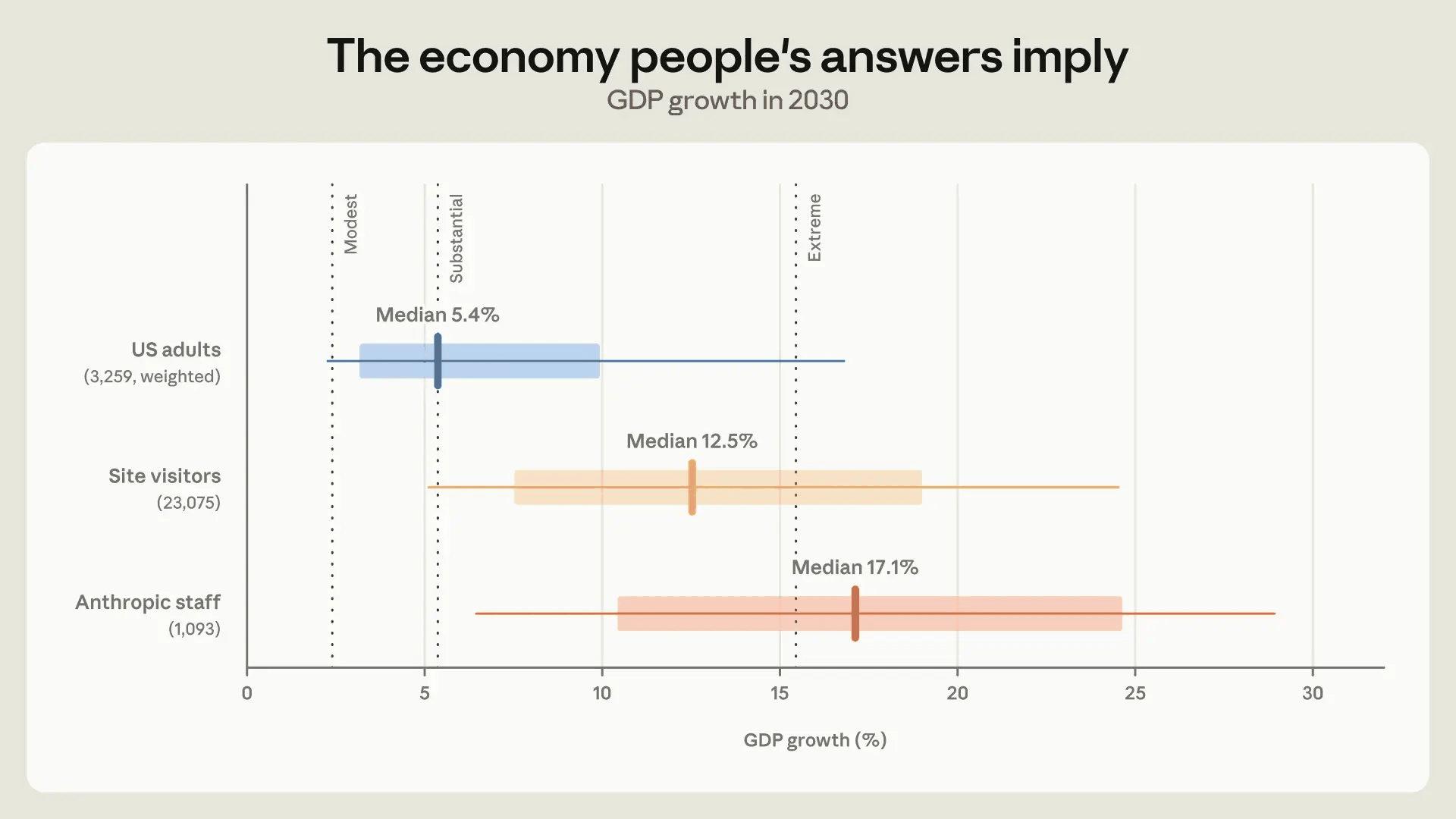
For scale: the US economy has grown about 2% a year for a long time. The last time it grew 17% in a year was 1941 to 1943, when the whole country retooled for war. The people closest to this expect a wartime economy, without the war.
And growth isn't paychecks. The line marked “Extreme” is Anthropic's scenario where AI does nearly all knowledge work on its own: the economy grows about 15% a year, knowledge workers' wages fall, and unemployment climbs past typical recession levels. The staff median sits just past it.
Ask about jobs and both groups reason the same way. American workers who expect AI to be able to do 80% or more of their work forecast about 12% unemployment by 2030, worse than the worst of the 2008 crash. Anthropic's staff show the same pattern, and more than half of them put their own work in that bracket.
Anthropic's scenario explorer has the numbers to see where the growth goes. Here is how each version of 2030 splits the economy between paychecks and everything else:
- Without AIworked back
- Modestabout like the internet
- Substantialhalf of knowledge work
- Extremenearly all of it
The numbers
| US economy in 2030 | Size | Share to workers | Paid to workers | To owners |
|---|---|---|---|---|
| Without AI (worked back) | $33.6T | 60.0% | $20.1T | $13.4T |
| Modest | $34.1T | 59.4% | $20.3T | $13.8T |
| Substantial | $36.3T | 56.1% | $20.4T | $15.9T |
| Extreme | $44.4T | 45.2% | $20.1T | $24.3T |
The pie grows by as much as a third. The paychecks stay at about $20 trillion in every version. Everything else, the growth included, goes to whoever owns the machines. A booming economy whose paychecks don't follow. That's my friend's worry, on a chart.
The survey's headline finding is the gap itself. The public and the people building this mostly agree on what AI can do today. They disagree on how fast it will get better and how far it will spread. Which makes me think my friend was generous: a lot of people don't have a realistic sense of the end yet either.
The government question isn't idle. In the US, roughly half of federal revenue comes from individual income taxes, and about another third from payroll taxes. One way or another, most of it is a tax on people working. Take the work away and you've taken away the floor the government stands on, at the same moment more people need it to catch them.
And it isn't only hypothetical anymore. One of the first places this site could point to jobs actually shrinking: call-center jobs worldwide, which grew about 4% a year for fifteen years, are now shrinking about 4% a year. I can't tell how much of that is AI. The speed of the turn is the point.
There's an old problem hiding in his question, too. You can't sell to people who don't earn. A market needs customers, and customers need incomes. If the incomes go first, the market follows them down, oligarchs included.
Oligarchs into communism
Then he sent the line that started the rest of this. Ironically, he said, the capitalist oligarchs are going to technologically advance us into benevolent communism. He followed it with a GIF of Kenneth from 30 Rock nervously gulping a bottle of water, which is about right.
Yes, exactly. It's really, really strange.
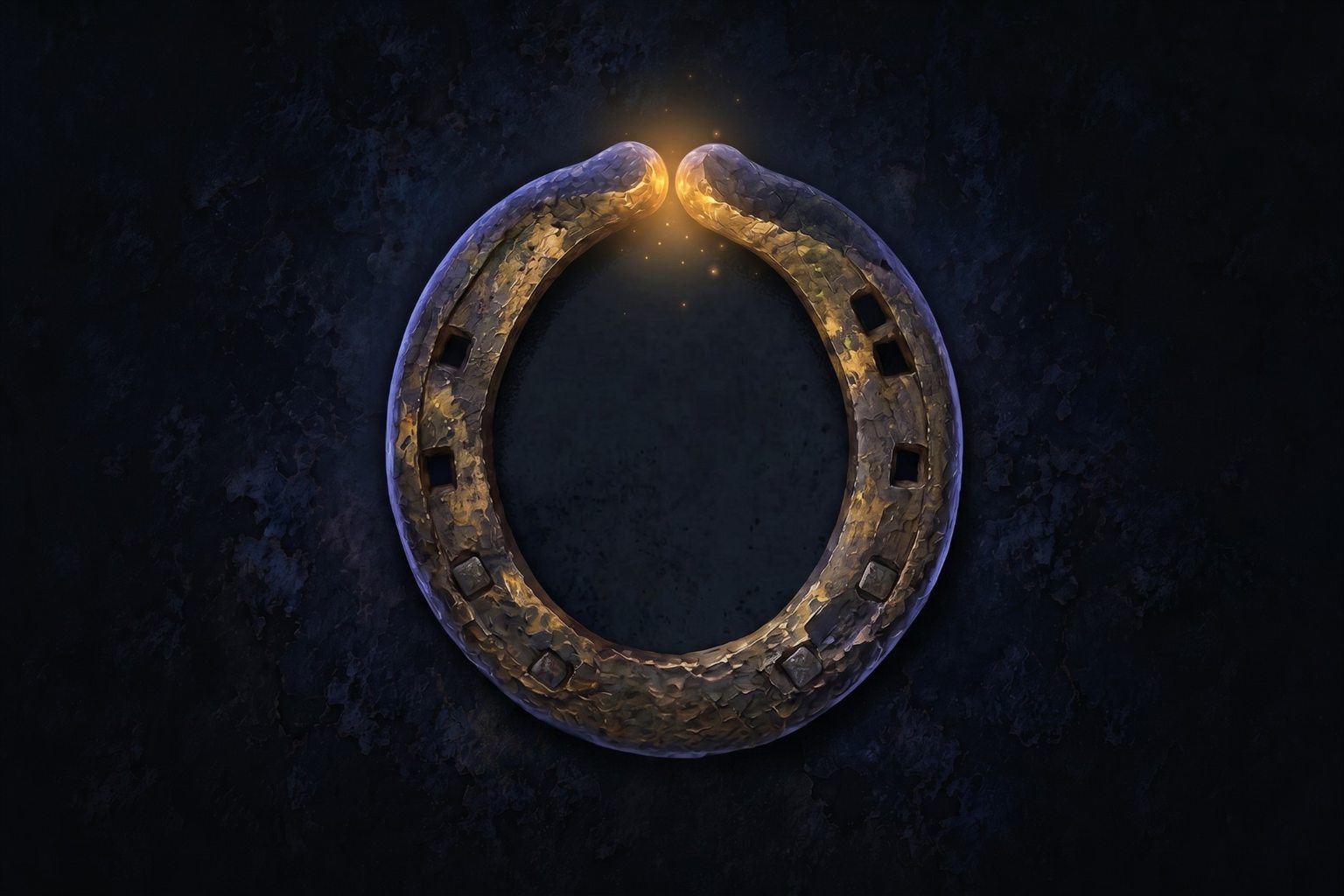
I'd been having nearly the same conversation with a different friend, a staunch conservative. Not conservative by cultural association, but the kind who has Ideas about classical economics. It isn't a conversation I'd often had on this kind of thing. What I tried to explain was that libertarianism and liberalism meet at the ends of the horseshoe when there's more slack in the system for personal freedom.
Follow it through. Things will be perfectly fiscally conservative: the books will be out of our hands. The markets will be perfect. Capitalism comes around to meet the communism that's never been tried, the kind with no labor and perfectly efficient markets.
Not even globalism survives. Too inefficient. Shipping things around the world to save on labor makes no sense once there's no labor to save on. I told that friend there are no globalists after this. It eats everything: all of politics, every institution. The people he worries about end up like the Roman Senate after the Republic, still meeting, still giving speeches, no longer where anything gets decided. And if I'm consistent, the same goes for the people he's rooting for.
And it won't be statists making us eat bugs and live in pods, as the line goes. If anything, we'll end up eating heirloom tomatoes and living in houses built from local lumber.
The culture war runs out of fuel without an eternal revolution to wage. Nationalism too: with the end of zero-sum games, there's little left to protect. There'll be no immigrants, only tourists. That friend had asked me whether there's anywhere left on the planet to opt out of all of it, somewhere like the Congo or Siberia. Where I keep landing is that the Congo and the Sahara become largely scenery preferences, in a world where scarcity of almost everything is low and energy is too cheap to meter. Good news for living there. Bad news for hiding there.
The one thing that stays scarce is land. I told him I hadn't worked out the mechanics there, and I still haven't. But it matters for the middle. When work stops being worth much, whoever owns the ground and the machines holds most of what's left.
That's a confusing thing to parse all the way around, for the left as much as the right.
What happens when there are no more markets?
My friend said I'd nailed his anxiety attacks. He believes the invisible hand of the market is far better than politicians calling the shots, and his opinion of politicians is lower than I can print here. Markets pick winners and losers, but everything improves or dies, and everyone's standard of living rises dramatically over time, whether activists want to admit it or not.
Except, he added, for the children digging the minerals for our phone batteries. Sorry, kids.
That aside does a lot of work, and I respect him for including it. The invisible hand has a long record of lifting the average while someone else holds the bill. The middle of this will have its own version, and the bill will land, again, on whoever has the least leverage when it comes due.
Then he asked the question I can't stop hearing.
What happens when there are no more markets?
What comes after money
A long time ago, I asked on some crypto and economics forums: what's next after money? The question was widely derided. Not one person ventured an earnest answer.
I think this is it. The concept of exchange gets supplanted by automation. When I put it to my conservative friend, he called it the evolution of exchange, which is better than I'd put it.
Not all at once. I think for a while there'll be a transition layer, like the credits in science fiction, or a series of them, underneath everything: just a way to organize production, and run the system efficiently, as one big machine. It will become more and more automated, and less and less directly connected to the fulfillment of anyone's personal need and desire. A credit already puts a step between you and the thing you wanted. There will be more steps after it. Settling a debt might become abstract, something you hardly hold in your mind. As that efficiency creates slack in the system, the layer disappears, all together, from the view of those of us who depend on it.
Traditional finance and all its instruments, crypto, microtransactions, credit scores, global exchange, the card reader at the register. All of it becomes more abstract and less direct to us. Then, for the most part, it disappears from view altogether, until the fulfillment of personal need and desire is profoundly disconnected from exchange.
We've already walked partway. Most money is already just numbers in a bank's computer, and paying for something has shrunk from counting out cash to tapping a phone without looking. The next steps go the same direction, further. In Star Trek: First Contact, Captain Picard tells a woman from 2063 that money doesn't exist in his century. It plays as a throwaway line. I think it's a forecast, with the hard part left out.
- AlwaysCashYou count it out.
- 1950s onCardYou sign for it.
- 2010s onTapYou don't look.
- The middleCreditsIt runs underneath.
- After…You don't see it at all.
Nobody can afford to be out in front
Here's the hard part. Right now, it would be crazy to abandon our model of finance and exchange on an individual level. Nobody can afford to be out in front. Nor can a country. What could ruin lives more surely than letting go early, and then having things go differently, or having others hold on to the old model for a moment's gain or power?
But as things develop, as productivity rises and scarcity and labor fall, I think it starts to look crazy to hold on to it.
So the middle has two kinds of crazy in it: letting go too early, and holding on too long. The moment one turns into the other won't arrive for everyone at once. It'll come for the call-center worker years before the shareholder, and for some countries long before others. Each will wait to see who else lets go. It's the stag hunt from The bent scale again: the same trap, on a different board.
That gap is my friend's paycheck worry, said another way. The middle is the stretch where the old rules still bind the people with the least, and the new abundance mostly reaches the people with the most.
People have floated handholds for it. None of them is mine, and none of them is a plan, but they're worth knowing about:
- A dividend for everyoneAlaska has paid every resident a yearly share of its oil money, through the Permanent Fund, since 1982. Some propose doing the same with what AI earns.
- Taxing what does the workBill Gates suggested in 2017 that a robot that takes a worker's job could be taxed like the worker was.
- The government taking a stakeDays after Bernie Sanders made the case for public ownership, the President said in June the government may take stakes in OpenAI, Anthropic and xAI. When both ends of the horseshoe reach for the same handle, it's worth watching whose hands end up on it.
- Owning a sliceSam Altman proposed in 2021 a fund that would take a small yearly share of the biggest companies and of land, and pay it out to every adult.
- Promising the windfall in advanceResearchers at Oxford proposed in 2020 that AI companies commit now to share profits past some enormous threshold, before anyone knows who will cross it.
Each of these is a way of building the transition layer on purpose, instead of by accident.
And on the day I finished this draft, one of the companies building the thing tried something between the last two. Anthropic, the company that makes Claude, announced a Public Benefit Fund: 5% of its shares now, pending its stockholders' approval, and its board can add 2% more each time the company's value grows by half again past a set baseline. The money could go to nonprofits, or straight to particular groups of people, and the example it gives is workers knocked loose by AI. None of it can go to lobbying or politics. Counting its founders' pledge to give away 80% of their own stakes, and a matching program for staff who give theirs, Anthropic says about a fifth of the company will be set aside for the public good.
Notice how it grows. The bigger Anthropic gets, the bigger the fund: the public's share rises with the winner's. That's my friend's joke about the oligarchs, made a little less of a joke. It's a real step, and for now a promise. Who runs it, and how, Anthropic says it will publish in the coming months. I'll judge it by that, and by who it actually reaches.
The soup
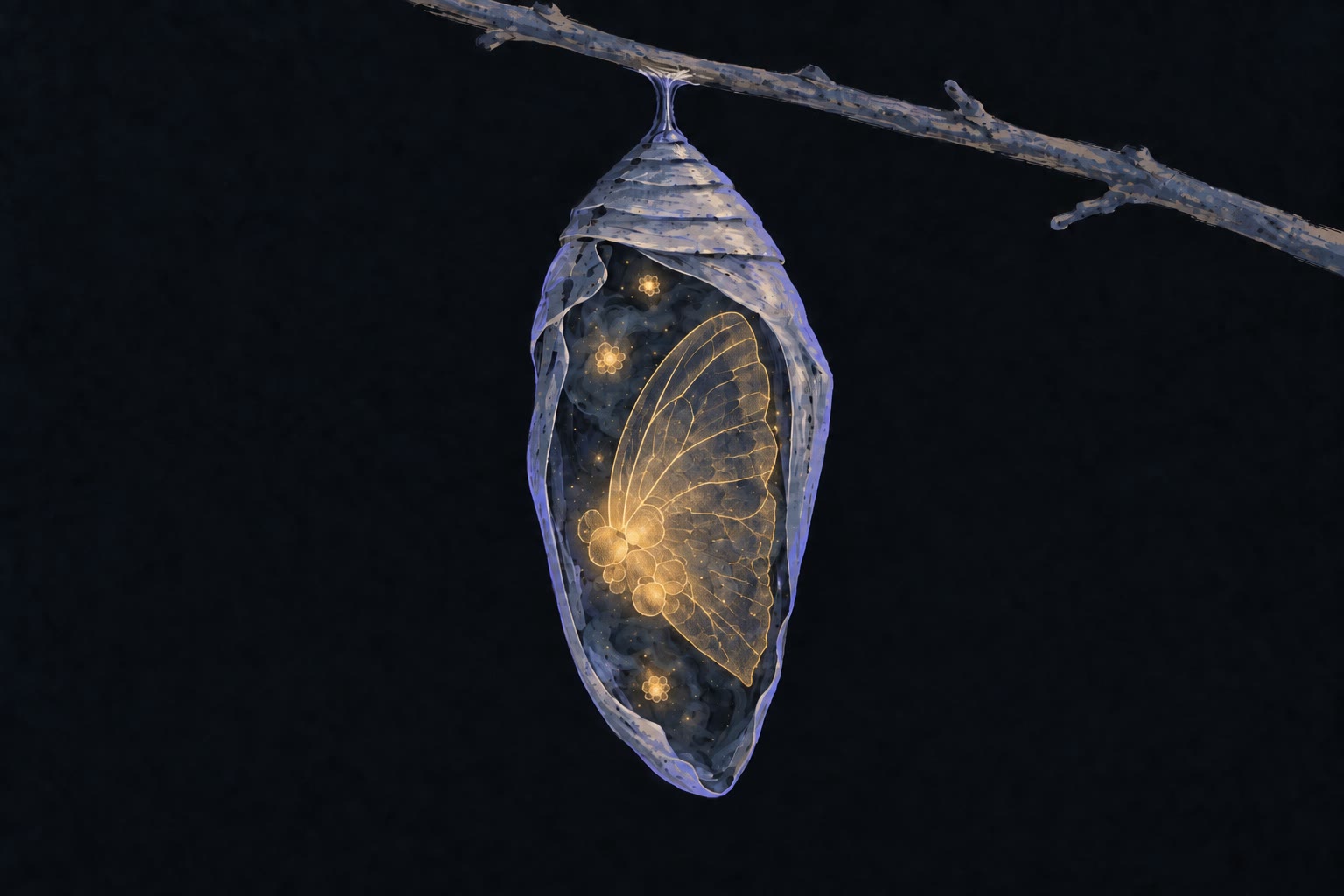
In The bent scale I wrote about the caterpillar dissolving into soup inside the chrysalis, and how only a few clusters of cells make it through to build the butterfly. I said which parts of us make it through is the whole question. My friend's point is that the soup is where we'll actually live. Not the caterpillar, not the butterfly. The soup. Probably for years.
I said as much to my conservative friend, late one night, after laying out the best version of where all this could go. A world where he and his family could live completely unmolested, free of the tech if they chose. Then:
I honestly do think it's possible. I just don't know how we get there.
If I had to name one thing that has to survive it, it's a floor under the people in the middle: while they can still earn, and after they can't. That's where the handles matter most. The rules for the middle haven't been written yet, and whoever writes them will be watching what the rest of us demand, and what we tolerate.
Most of what I write here has a best-before date. This one is about the part I can't see, so it starts out expired. Check back in the middle.
When I said all this might be good fuel for a new article, my friend said sure, as long as it had real thought and consideration in it. Not cable news catastrophizing and demonizing. That's the bar I've tried to clear. You can tell me if I didn't.
He also said something kind about how I'd put it all. I told him I'd wait until any of it comes true to accept the compliment. That's still my position.
So much good for everybody is just on the other side.
I hope.
Written with Claude, from a text thread with a friend this fall, after he'd read the site. He encouraged me to write it up. His side is paraphrased, lightly. Mine is close to how I wrote it, reordered and smoothed. The conservative friend I'd talked it through with a couple of weeks earlier is paraphrased too, and a few of my lines here come from that thread, among them the Roman Senate, the land and the line set apart in “The soup.” The chess endings, the tax figures, the Star Trek line and the list of handholds were added while writing it up; the links were added afterward.
The chart of paychecks is worked from Anthropic's scenario explorer, and the strip of money fading from view is drawn in the page. The chrysalis is the one from The bent scale. The horseshoe was made with Nano Banana, Google's Gemini image model, from prompts Claude wrote in the style of The bent scale's pictures: it took the shape of one try and the hammered iron of another, and had its nail moved out of sight. Like those pictures, it illustrates the argument and isn't evidence for it.
Anthropic's survey and its Public Benefit Fund went in on October 18, the day the fund was announced, at my asking. Both are Anthropic's, and Claude is made by Anthropic, which matters more than usual in a piece that leans on them. The chart is Anthropic's own, reproduced as published.
The television at the top is the one from I’m not a meteorologist, but I feel like one, and the foot of that page says more about it. Its music is made in your browser as you listen, with no recording. The weather on it is for roughly where you are: this site’s own server works that out from your internet address, which isn’t sent anywhere or kept, and only your town’s rough location goes out to get the forecast. Weather data by Open-Meteo, location by DB-IP, both under CC BY 4.0.
This is a companion to Very Weird, Very Quick, which is the long version — where AI actually is right now, how fast it is moving, and why it is getting harder to tell what is real. It picks up where “The chrysalis” in The bent scale leaves off.